
What Causes Throbbing Pain & Temperature Sensitivity in A Tooth?

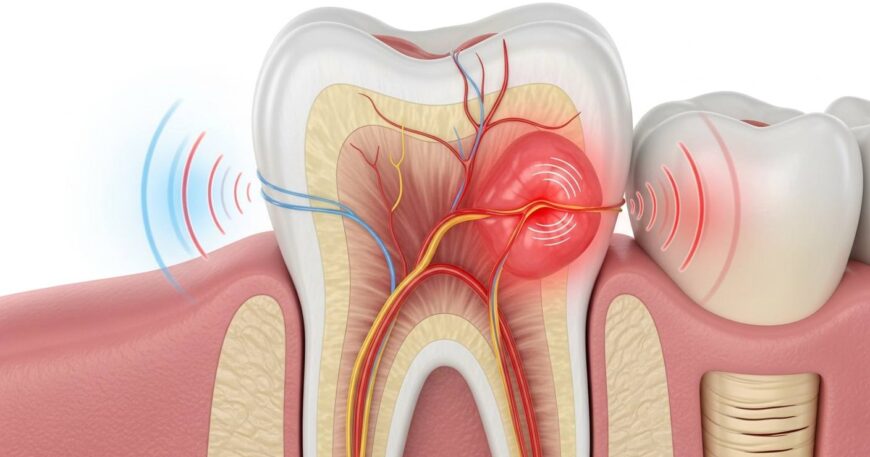
If your tooth throbs and hurts badly when you sip hot or cold drinks, it usually means the tooth’s inner nerve (the pulp) is irritated or infected. In other words, the pulp – which contains nerves and blood vessels – is being exposed to stimuli it shouldn’t normally feel. Dentists call hot/cold pain in teeth “dentin hypersensitivity”, and it happens when enamel or gum tissue is worn away so that the dentin tubules reach the nerve. When the pain throbs, it’s often a sign that the pulp is inflamed (pulpitis) or infected, not just a mild sensitivity. In many cases, this points to deep decay or a crack that lets bacteria into the pulp. Such problems allow hot or cold to reach the nerve and cause that painful, pulsing ache.
The above diagram shows a tooth’s layers. Enamel is the hard outer shell, dentin is the middle layer with tiny tubules, and pulp is the soft center with nerves. If the enamel chips or erodes, cold or hot can travel down those dentin tubes to the nerve. Bacteria from a cavity or crack can also inflame the pulp, causing throbbing pain. For example, Cleveland Clinic explains that irreversible pulpitis (inflamed pulp) causes a sensitivity to heat and cold that lasts for seconds and often feels like a throbbing, aching pain. In short, throbbing hot/cold pain usually means the nerve is upset – often because decay or damage has reached the inner pulp.
Common Causes of Pain and Sensitivity
Many things can expose the tooth’s nerve or irritate the pulp, leading to hot/cold sensitivity and throbbing pain. Common causes include:
-
Tooth Decay and Pulpitis: Deep cavities are the most common culprit. When decay eats through enamel and dentin, it can reach the pulp. Bacteria then infect and inflame the nerve, causing sharp sensitivity and often intense throbbing. An abscess (a pus pocket) at the tooth root may form, and dentists describe abscess pain as a gnawing or throbbing ache that gets worse with heat or cold. In other words, a big cavity or an abscessed tooth will often “throb” with hot/cold stimuli because the pulp is infected.
-
Cracked or Chipped Tooth: A fracture, crack or chip can let irritating substances into the tooth. Even a tiny crack exposes dentin, so hot/cold liquids or food can hit the nerve underneath. Cleveland Clinic notes that a cracked tooth “may cause symptoms like pain and swelling” and feels sensitive to temperature changes. In practice, biting down or change in temperature can send sharp or throbbing pain through a cracked tooth. A small crack often causes brief shooting pain to hot/cold, but a larger crack that reaches the pulp can cause persistent throbbing as well.
-
Gum Disease or Receding Gums: Healthy gums cover the tooth roots, but gum disease or brushing too hard can pull gums away, revealing root surfaces. Root dentin is not protected by enamel, so it is very sensitive. Cleveland Clinic explains that gum disease or receding gums can “expose tooth roots,” making teeth more sensitive to heat and cold. When roots are exposed, you might feel stabbing pain from hot or cold. If gum infection spreads deep enough, it can eventually irritate the pulp and cause a dull, throbbing ache under the gum.
-
Worn Enamel (Bruxism, Diet, Aging): Grinding your teeth or eating acidic foods can wear down enamel over time. For example, teeth grinding (bruxism) literally shaves off enamel, exposing the softer dentin. Similarly, acid from sodas or citrus can erode the enamel surface. Once dentin is exposed, heat or cold can easily reach the nerve through the open tubules. As Cleveland Clinic notes, “clenching or grinding your teeth wears down enamel and can expose dentin”. With enamel worn thin, even air or cool drink can cause sharp pains, and continued stress may even lead to cracks or pulp inflammation with throbbing discomfort.
-
Dental Work and Other Factors: Sometimes dental procedures (like a deep filling or crown) can cause temporary sensitivity, especially if the pulp was nudged during treatment. Whitening products can also make teeth more sensitive for a time. These are usually short-term. However, lingering throbbing pain usually means the problem is untreated decay or damage, not just a recent dental work.
Each of these issues – cavities, cracks, exposed roots, or worn enamel – ultimately has the same effect: hot, cold or sweet substances can directly stimulate the tooth’s nerve. When the nerve is inflamed or infected, the pain is often not just a quick “zing,” but a deep, pulsing ache. If you get the impression the pain comes in waves or feels like a heartbeat, it means the pulp pressure is building and you should act quickly.
When to Seek Professional Care
Throbbing tooth pain paired with heat or cold sensitivity almost always means you need prompt dental care. As Cleveland Clinic warns, “if the pain is sharp or doesn’t go away, it could be a sign of a more serious issue”. In many cases, only a dentist can remove the infection and save the tooth – often by doing a filling, crown, or a root canal. A root canal treatment removes the inflamed pulp and stops the throbbing pain by eliminating the source of infection.
Don’t wait: even if the pain subsides on its own (sometimes a dead nerve stops hurting), the infection can spread and cause worse problems. The Cleveland Clinic notes that untreated tooth infections can spread to jaw and face tissues and even the bloodstream.
In the meantime, you can try a few things at home: use a desensitizing toothpaste, avoid extremely hot or cold foods, and brush gently with a soft brush. Over-the-counter pain relievers and a warm salt-water rinse can help with the pain and swelling temporarily. But these are only short-term measures. Throbbing, temperature-sensitive tooth pain is a red flag for your dental health – the only real solution is to have a dentist diagnose and treat the cause as soon as possible.
Conclusion
If one of your teeth is really sensitive to hot and cold and feels like it’s throbbing, it usually means the inner nerve is involved. This often happens when decay or a crack lets bacteria reach the pulp. It requires prompt treatment (like a filling or root canal) to stop the infection and relieve the pain. In short, throbbing hot/cold tooth pain is not normal and should be checked by a dentist right away.
