
Linea Alba Mouth Treatment: What’s Actually Going On Inside Your Cheek

You noticed a white line inside your cheek and now you’re convinced something is seriously wrong. Been there. Most people who search for linea alba mouth treatment end up relieved once they understand what they’re actually dealing with. Short answer? It’s almost always harmless and your body created it on purpose.
Your Cheek Is Just Protecting Itself
Think about what happens when you carry heavy grocery bags and the handles dig into your palm. After a while, that skin gets tougher. Your inner cheek does the exact same thing when your teeth keep rubbing against it day after day.
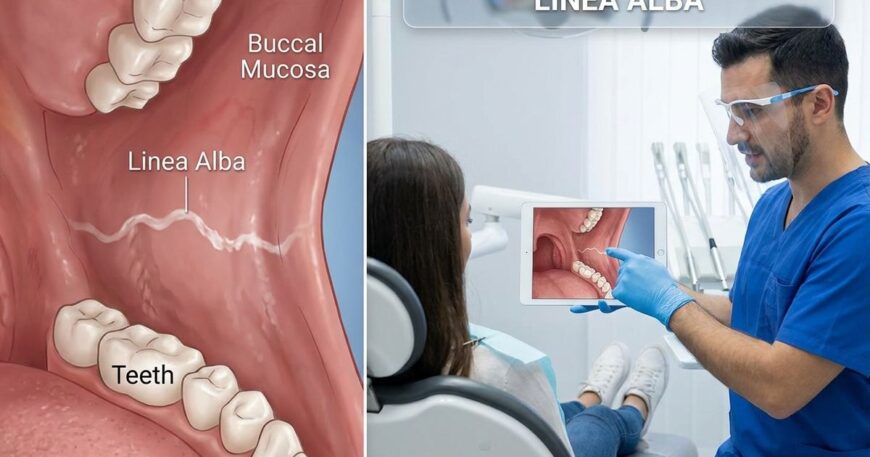
That white line sitting along where your top and bottom teeth meet is called linea alba. The tissue thickened up from friction. That’s genuinely the whole story in most cases. No infection, no virus, no cancer. Just your body being smart about repeated pressure.
Lots of people have it and never notice. A dentist spots it during a cleaning and mentions it casually, and suddenly the patient is horrified thinking something terrible is happening. It’s not.
Where the Friction Actually Comes From
Teeth grinding is probably the biggest cause. A lot of people grind at night without knowing it. Their partner hears the sound, or they wake up with a sore jaw, or sometimes a dentist notices the worn-down teeth before the person ever connects the dots.
Clenching during the day counts too. Stress does this to people. You’re sitting in traffic or staring at a difficult email and your jaw quietly tightens up for twenty minutes straight. Over weeks and months that adds up.
Cheek biting is another one. Some people chew the inside of their cheek when they’re thinking or anxious. It becomes such a background habit that they genuinely don’t realize they’re doing it half the time.
Poorly fitted dentures rubbing against the cheek wall can cause it. Sharp tooth edges that keep catching on the same spot will do it too. Even braces can contribute depending on how they sit inside the mouth.
What Treatment Actually Looks Like
Here’s the thing nobody tells you upfront. Most of the time there’s nothing to treat. If the white line isn’t painful, isn’t growing, and isn’t causing any other issues, dentists leave it completely alone. It doesn’t need medication or removal or any procedure whatsoever.
Where management comes in is when there’s an obvious cause creating ongoing friction. If you’re grinding your teeth, a dentist will make you a custom nightguard. You wear it while sleeping and it puts a physical barrier between your teeth and cheek so the rubbing stops. The tissue usually calms down once the irritation source is gone.
Sharp or uneven teeth that keep catching on the cheek can be lightly smoothed down. It’s a quick painless procedure and solves the problem at the source. Dentures that don’t fit right can be adjusted so they stop pressing into the wrong areas.
Cheek biting is harder to fix because it lives in the habit part of your brain. Becoming aware of it is step one. A lot of people find the habit gets worse during stressful periods so dealing with the stress actually does more than any dental fix could.
People Confuse This With Leukoplakia and That’s Worth Clearing Up
Leukoplakia is the white patch condition that actually does need attention. It can show up anywhere inside the mouth, has irregular uneven borders, and sometimes carries a real risk of becoming something more serious over time.
Linea alba only ever sits on that specific bite line. It has clean predictable edges. It doesn’t carry cancer risk. A dentist can tell the difference just by looking at it for about ten seconds. No biopsy, no lab work, no referral needed in a typical case.
If your dentist looked at it and said linea alba, you can take that at face value. They know what it looks like.
When You Should Stop Waiting and Call a Dentist
If nobody has officially looked at it yet, go get it confirmed. That’s not because it’s likely dangerous but because knowing for certain is better than guessing.
After that, watch for a few things. If it starts hurting, develops a sore, or bleeds when you touch it, those are reasons to go back. If the texture changes and starts feeling raised or rough instead of flat and smooth, mention it at your next visit. New white patches appearing in other parts of your mouth also deserve attention.
None of those changes necessarily mean something serious is happening. But they mean the picture has changed and fresh eyes on it make sense.
Here’s What to Actually Take Away From This
Linea alba mouth treatment sounds like it should involve some complicated dental procedure. In reality, for the vast majority of people, the treatment is just figuring out what’s causing the friction and stopping it. Sometimes that means a nightguard. Sometimes that means a small tooth adjustment. And sometimes it means absolutely nothing because the line is just sitting there quietly doing no harm at all.
If you’ve been staring at that white line worrying about it, you can probably breathe now. Get it confirmed by a dentist if you haven’t already and then let it go.
