
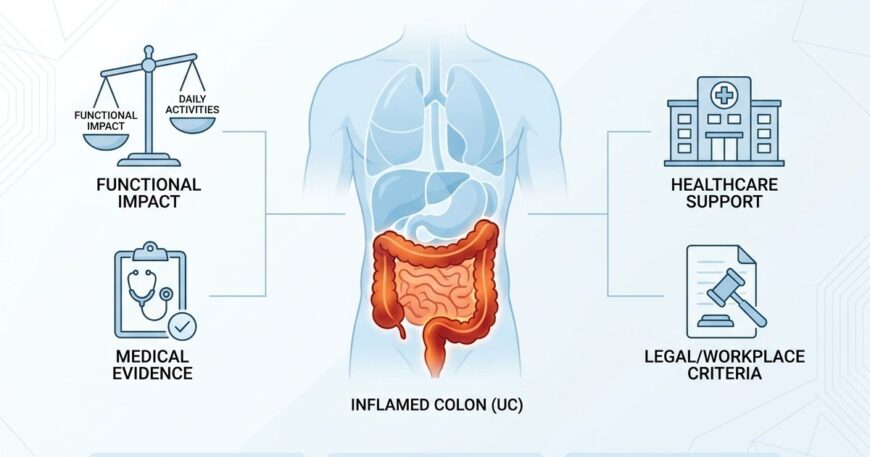
Is Ulcerative Colitis a Disability? A Comprehensive Overview

Short answer, yes. Ulcerative colitis can qualify as a disability under the Americans with Disabilities Act and through Social Security disability programs. But that one-word answer leaves out a lot, because qualifying is not as simple as showing up with a diagnosis and expecting approval.
UC is strange in the sense that two people can have the exact same diagnosis and live completely different lives because of it. One person takes their medication, stays mostly stable, goes to work, and manages. Another person is hospitalized three times a year, cannot keep weight on, and genuinely cannot commit to being somewhere at 9am because their body gives them no predictable schedule. The law is not blind to that difference. Severity is really what everything hinges on.
What the ADA Covers
Digestion is specifically listed as a major life activity under the ADA, so UC fits the definition without needing much argument. If you work somewhere with 15 or more employees, your employer has a legal obligation to provide reasonable accommodations.
What that looks like in real life varies. Unrestricted bathroom access is the obvious one. But it could also mean being allowed to work from home when things are bad, having a flexible schedule so you are not penalized for slow mornings, or temporarily shifting duties during a recovery period. You do not have to be mid-flare to ask for any of this. Your diagnosis history, even if you are currently doing okay, is enough to trigger those protections.
Getting Social Security to Approve UC
This process is harder and honestly frustrating for a lot of people who go through it. The SSA does list ulcerative colitis in its official medical guide under Section 5.06, Inflammatory Bowel Disease. Being in the guide does not mean automatic approval. Not even close.
The SSA wants documentation. Real, detailed, clinical documentation showing that the condition is severe, has persisted or will persist for at least a year, and that it genuinely stops you from holding any full-time job. They go through colonoscopy results, biopsy reports, imaging, blood work showing things like anemia or protein deficiency, hospitalization records, and whatever your gastroenterologist has written about your day-to-day limitations.
Symptoms that tend to matter most in these reviews are things like using the bathroom 10 or more times daily during flares, abdominal pain that interrupts normal tasks, weight loss that keeps happening despite attempts to address it, fatigue that makes sustained physical activity impossible, and complications beyond the digestive system like joint pain or skin problems that pile on top of everything else.
There is also a secondary pathway called a Residual Functional Capacity assessment. This comes into play when your case does not fit perfectly into the Blue Book criteria. Basically the SSA asks what you can actually do, and whether those limitations make it impossible to reliably perform any job. A lot of people who get denied the first time end up approved through this route eventually.
Veterans and VA Ratings
Veterans who can tie their UC to military service apply for ratings through the VA under diagnostic code 7323. The scale runs from 10% for mild intermittent symptoms up to 100% for cases involving constant severe disease, serious bleeding, or a permanent colostomy. Moderate disease with bloody stools and some weight loss typically lands around 30%. Frequent severe attacks with noticeable physical decline usually fall around 60%.
If a veteran had their colon removed because of UC, they generally get a 100% rating while recovering, and then the VA takes another look once that period ends.
The Real Reason Claims Get Denied
Most denied claims are not denied because someone was faking or exaggerating. They get denied because the paperwork does not reflect what life with severe UC actually looks like on a Tuesday morning.
Here is something that does not get said enough. People with chronic illness get used to functioning through misery. They learn to describe their symptoms in understated ways because they have been doing it for years, or because they do not want to seem like they are complaining, or because the appointment is only 15 minutes and they hit the highlights and move on. Whatever ends up written in those visit notes becomes the official record. If your chart reads like someone managing okay, that is what a claims reviewer sees.
Being specific at appointments actually matters. How many times a day are you in the bathroom. Have you missed work because of this. What does your energy feel like by noon. What have you stopped doing because your body cannot keep up. These are not small details. They are what separates a chart that reflects your real situation from one that undersells it.
Things People Commonly Get Wrong
People assume UC only qualifies as a disability after surgery, like after a colectomy. That is not how the evaluation works. Medically managed UC that is genuinely severe can qualify just as much. What the SSA and VA are measuring is functional impact, not which treatment path someone is on.
People also assume that looking healthy means the case will not be taken seriously. UC is invisible for most people between flares. You can be out to dinner looking fine on a Saturday and completely unable to leave your house on a Wednesday. The law actually does account for this. Episodic conditions, meaning ones that come and go unpredictably, are still recognized as disabling. The unpredictability itself is part of the problem.
Where Things Actually Stand
UC is recognized under U.S. law as a condition that can genuinely disable someone. Whether that recognition turns into actual workplace protections or financial benefits for you specifically depends on your records and how well they reflect the real day-to-day reality of living with this disease.
If you are at a point where work is becoming impossible to maintain, the most concrete thing you can do is talk honestly with your doctor and make sure your medical records tell the truth about what your life looks like. Everything else in this process gets built on top of that foundation.
