

Can Twins Cause False Negative Pregnancy Test? A Comprehensive Overview

Yes, but it’s very rare. Normally, a home pregnancy test checks for a pregnancy hormone (hCG) in your urine and gives a positive result when the hormone is present. When you’re pregnant with twins, your body makes even more hCG than with a single baby. Paradoxically, in extremely high amounts the test can become overloaded and fail to show a positive line. This glitch is called the “hook effect.”
In other words, a twin pregnancy can in very rare cases cause a test to say “not pregnant,” even though you are carrying two babies. Most of the time, though, a negative result has simpler explanations (like testing too early), so it’s not usually because of twins.
How the Hook Effect Works
Home pregnancy tests rely on a chemical reaction. They contain antibodies that latch onto hCG molecules in urine. When enough hCG is captured, the test shows a positive sign or line. However, if the hCG level is extremely high (as it can be with twins or certain unusual pregnancies), it can actually “flood” the test.
Imagine the test like a bucket that collects raindrops (hCG). Normally a few drops fill the bucket and trigger a signal. But if the bucket is overflowing with too much rain, the overflow can prevent the mechanism from working. In this case, the test can’t form the positive line, so it shows a negative result even though the hormone is there. Doctors call this the hook effect. It’s very uncommon, but it explains why a test can fail when hormone levels go beyond what the test is designed to handle.
Other Reasons for a False Negative
Twins are an unusual cause of a false negative. There are more common reasons a pregnancy test might say “no” even if you are pregnant:
-
Testing too early. If you take the test before hCG has built up enough (for example, before your missed period), the hormone level may be too low for the test to detect.
-
Diluted urine. Drinking a lot of fluids or not using first-morning urine can water down hCG in your sample. Lower concentration might not trigger a positive result.
-
Expired or faulty test. An old or damaged test may not work correctly. Always check the expiration date and storage instructions.
-
Incorrect usage. Not following the instructions (such as dipping too briefly, using too little urine, or reading the result too soon or too late) can give a wrong reading.
-
Very rare conditions. Certain unusual conditions (like a molar pregnancy) or medications can also affect hCG levels. These are uncommon and would need a doctor’s diagnosis.
Usually, if your test is negative, one of these common issues is the cause. Twin-related false negatives are truly a rare exception.
What To Do If You Suspect Pregnancy
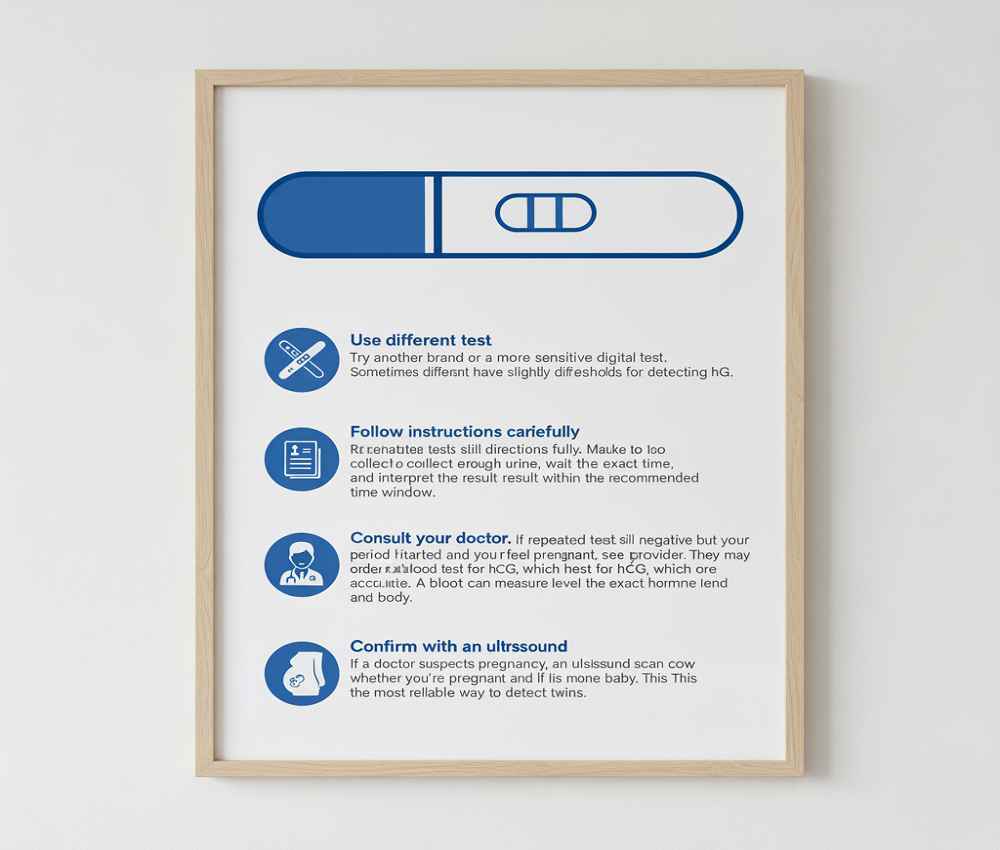
If your home pregnancy test is negative but you still think you might be pregnant (for example, you’ve missed a period or you have pregnancy symptoms), try these steps:
-
Wait a few days and test again. Each day after implantation, your hCG roughly doubles. Retesting in a couple of days gives the hormone more time to rise. Always use first-morning urine for the strongest sample.
-
Use a different test. Try another brand or a more sensitive digital test. Sometimes different tests have slightly different thresholds for detecting hCG.
-
Follow instructions carefully. Read the test kit directions fully. Make sure you collect enough urine, wait the exact time, and interpret the result within the recommended time window.
-
Consult your doctor. If repeated tests are still negative but your period hasn’t started and you feel pregnant, see a health care provider. They may order a blood test for hCG, which is much more sensitive and accurate. A blood test can measure the exact hormone level in your body.
-
Confirm with an ultrasound. If a doctor suspects pregnancy, an ultrasound scan can show whether you’re pregnant and if there is more than one baby. This is the most reliable way to detect twins.
By taking these steps, you can be sure of the answer. A blood test or ultrasound can quickly clear up any confusion.
Summary
In most cases, pregnancy tests work well, and a false negative is usually due to timing or user error. It is very unusual for carrying twins to cause a negative result, because the “hook effect” happens only with extremely high hCG levels. If you’re ever unsure about a test result, the best approach is to retest after a little time and check with your doctor. They can give you a definitive answer. In the end, paying attention to your symptoms and following up with a professional will ensure that you get accurate information about your pregnancy.
