
Black Lines on Molars: Causes, What They Mean, and When to Act

You see a dark line on your back tooth and immediately you start thinking it is a cavity. Many people go through this exact same moment. But here is the thing, black lines on molars are not always related to decay. There are several different reasons why this happens, and most of them are honestly not that serious. Because of how back teeth are shaped, they tend to collect more staining, bacteria and deposits compared to your front teeth. So rather than worrying right away, it helps to first understand what could actually be causing it.
Why Back Teeth Get These Lines More Than Front Teeth
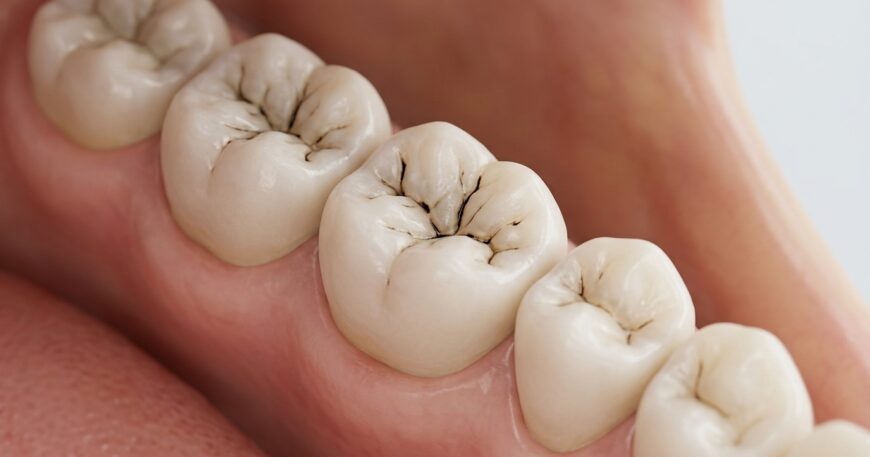
Your back teeth, if you look at them, they are not smooth like front teeth. Deep grooves and channels are running all across the biting surface of molars. These are called fissures and their job is to help you break down food properly when chewing. The problem with these grooves is that they also trap everything else, food particles, coffee, bacteria, plaque, all of it.
Even if you brush carefully every day, the bristles of your toothbrush cannot physically reach the very bottom of these grooves. So whatever settles inside tends to stay there. This is the main reason why black lines appear on molars specifically. It is not necessarily about how clean you keep your teeth. It is more about the shape of the tooth itself working against you.
In Most Cases It Is Only Staining
A dark line on a molar, most of the time it is just staining from things you eat and drink regularly. Coffee, tea, red wine, all of these drinks contain pigments that slowly build up inside the molar grooves over months and years. Tobacco is another major reason, whether you smoke it or chew it. Certain foods too, like dark berries, soy sauce or balsamic vinegar, can contribute to this kind of discoloration.
These pigments do not just sit loosely on the tooth surface. They actually go into the microscopic texture of the enamel and collect in the deepest parts of the groove. This is why the dark line forms exactly there and not somewhere else on the tooth. What makes this confusing is that staining and a cavity look almost the same from outside. Without proper examination, distinguishing between the two just by looking is genuinely very difficult.
Tartar Also Becomes Dark Over Time
One more common reason for these lines is tartar. It starts as plaque, the soft white coating that forms on teeth during the day. When plaque is not removed consistently it hardens by absorbing minerals from saliva. This hardened material is called tartar or calculus.
Fresh tartar is usually pale yellow or off-white in color. But because tartar is porous it absorbs stains from everything you consume, and after months or years it turns brown and then nearly black. Along the gumline and inside molar grooves is exactly where tartar tends to accumulate most, which is also where people notice these dark lines.
Something important here, tartar cannot be removed with brushing at home. It is firmly bonded to the tooth and removing it requires professional scaling at a dental clinic, there is no way around this.
Some Bacteria Leave Black Lines That Are Actually Not Harmful
This is something most patients are not aware of. Certain bacteria that exist naturally in your mouth, they produce iron compounds as part of their normal daily activity. These iron compounds leave a very specific stain pattern on the tooth, usually a thin defined black line along the gumline, most visible on the inner surfaces of back teeth.
This is called chromogenic bacterial staining and it has nothing to do with tooth decay. The enamel is not damaged at all. Some studies even suggest that people who develop this type of staining may have fewer cavities on average because these bacteria possibly compete with the more harmful cavity-causing strains. Children get this type of staining quite often and parents almost always assume it is from too much sugar, but that is not how it works. The stain comes back after professional cleaning, but it remains harmless to the actual tooth.
When the Dark Line Means There Is Real Decay
So when is a black line actually a cavity? Fissure decay, meaning decay that starts inside the grooves on the biting surface, is the type most likely to look like a dark line. What happens is bacteria produce acids that slowly dissolve the enamel from inside the groove. As the enamel breaks down the area darkens and this is what you see from the outside.
The tricky part is that early fissure decay looks almost the same as a stain because you are only seeing the surface layer. The damage is happening beneath it. Some signs that suggest decay more than staining, the line is sitting inside a groove on the biting surface rather than along the gumline, the tooth feels sensitive to cold drinks or something sweet, or the line appeared or darkened within a short recent period rather than gradually over many years.
Decay that is ignored will eventually reach the dentin layer under the enamel, and dentin is softer so it spreads faster there. A filling becomes necessary at that point. But if it is caught early enough, sometimes no drilling is needed at all.
Old Fillings Can Make the Tooth Look Darker
Molars that were filled previously with silver amalgam sometimes develop dark areas that can look like new decay to an untrained eye. Two things cause this. First, metal fillings corrode slightly at their edges after many years and this creates a dark outline around the filling border. Second, the metal inside the tooth casts a shadow through the thin enamel around it which makes the surrounding area appear darker than it actually is.
Mostly this is a cosmetic issue. But if the edge of an old filling looks cracked or broken it still deserves attention because bacteria can sneak underneath a damaged filling and start decay in the hidden area below it.
How a Dentist Actually Determines What It Is
When you point out a dark line, your dentist does not simply look and guess. A thin metal instrument called a dental explorer is used to gently probe and touch the area. A groove with staining or tartar feels hard and smooth under this probe. Decay feels different because the enamel there is partially broken down, giving a slight softness or stickiness when touched.
If there is still uncertainty after probing, a bitewing X-ray is taken. X-rays reveal whether decay has gone below the enamel surface into the dentin, even when the surface still looks mostly fine. Using both probing and X-ray imaging together is how a dentist reaches a reliable answer instead of just making assumptions.
What Happens If You Leave It and Do Nothing
If the line is only staining, ignoring it means it gets darker and harder to remove as time passes but the tooth itself stays structurally fine. If it is tartar, leaving it leads eventually to gum disease because bacteria in the deposit keep irritating the gum tissue around it. If it is decay, things get worse the longer it is left alone. A small cavity that could have been treated with a simple quick filling becomes a larger cavity, then it reaches the nerve, and then a root canal becomes necessary. The longer decay continues the more complicated and expensive the treatment becomes, and this alone is good enough reason to get any suspicious dark line checked early.
Dark Lines Specifically on Children’s Molars
Parents become especially worried when dark lines appear on their child’s back teeth. The chromogenic bacterial staining that was explained earlier is actually very common in children and accounts for a large number of these cases. It is not related to sugar intake or brushing habits. It is a bacterial characteristic that often changes naturally as the child gets older.
However, children’s enamel is thinner and more vulnerable than adult enamel, so decay progresses faster in young teeth. Any dark line on a child’s molar deserves a dental visit because looking at it from outside cannot tell you whether it is the harmless bacterial stain or early decay. A dentist can make this distinction very quickly.
